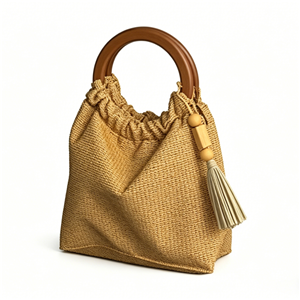
Durability testing for raffia tote recycled PP lining
Beach shoppers don’t baby their bags. Sun, salt, sand, sunscreen, and the occasional drench are part of the deal. If your raffia tote uses a recycled PP (rPP) lining, you need a durability program that’s auditable in the factory and credible to buyers—without requiring a full-blown lab. This guide lays out a practical, custom in-house matrix centered on the highest‑risk failure mode: handle pull‑out and elongation at the attachment points. You’ll also get reproducible parameters, clear pass/fail thresholds, and sourcing pointers aligned to public testing practices.
Acceptance criteria for durability testing raffia tote recycled PP lining
The targets below fit beach/resort use and can be tuned after pilot builds.
Test | Target/Threshold | Notes |
Handle static hold | No opening at 12 kg for 60 s; break ≥ 25 kgf | Record failure mode and elongation |
Handle fatigue | 5,000 cycles at 0–12 kg; elongation ≤ 10% | No stitch/attachment failure |
Seam tensile (grab) | ≥ 300 N small totes; ≥ 500 N large totes | For attachment/body seams |
Seam slippage | Opening ≤ 4 mm at agreed load | Tune to weave/raffia pattern |
Abrasion (Martindale) | No hole at 5,000 rubs; only slight fuzzing | Evaluate appearance grade |
Colorfastness to rubbing | Dry ≥ 4; Wet ≥ 3–4 (Gray Scale) | Crockmeter method |
UV/lightfastness (fabric) | Grade ≥ 3 after xenon exposure | Report hours/program |
UV weathering (rPP) | Acceptable retention after 300–500 h UVA‑340 | Report hours and kJ/m² @ 340 nm |
Sea water/perspiration | Color change/staining ≥ Grade 3–4 | Based on ISO/AATCC methods |
Lining puncture | ≥ 50–100 N (by thickness) | D4833/D6241/ISO 12236 analogs |
Peel/adhesion | Baseline ≥ 3–5 N/25 mm; ≥ 80% retention post‑aging | D903/ISO 2411 analogs |
Accelerated aging | No delamination; ≥ 80% adhesion retention | 60 °C / 70% RH, 72 h |
Test matrix: beach risks mapped to factory-capable methods
Beach/resort use loads the bag with UV, salt, sand, oils, and repeated lifts. Here’s how to translate those risks into checks you can run with modest equipment.
Risk | What can fail | Factory-capable test |
Repeated lifts | Handle attachment loosens or pulls out | Static hold at 12 kg; cyclic handle fatigue to 5,000 cycles |
UV/sunlight | Fade, embrittlement of rPP | Xenon lightfastness for fabrics; UVA‑340 weathering for rPP parts |
Salt, sweat, sea water | Staining, corrosion on fittings, adhesive creep | ISO sea water and perspiration colorfastness; post‑exposure inspection |
Sand ingress | Interior abrasion; closure jamming | Sand shaker exposure, 1,000 strokes; functional checks |
Sunscreen/oils | Staining, tackiness, bond weakening | Custom oil/sunscreen soak + abrasion; peel before/after |
Daily scuffing | Raffia fuzzing, lining wear | Martindale abrasion on body/lining/handles |
Heat/humidity storage | Delamination, odor | 60 °C / 70% RH aging; adhesion re‑test |
Step-by-step factory micro-tests
The following procedures are custom in‑house methods aligned with publicly described standards and luggage testing practices. They’re designed so your QA team can reproduce them and defend the results.
1) Handle static hold and pull‑out (priority)
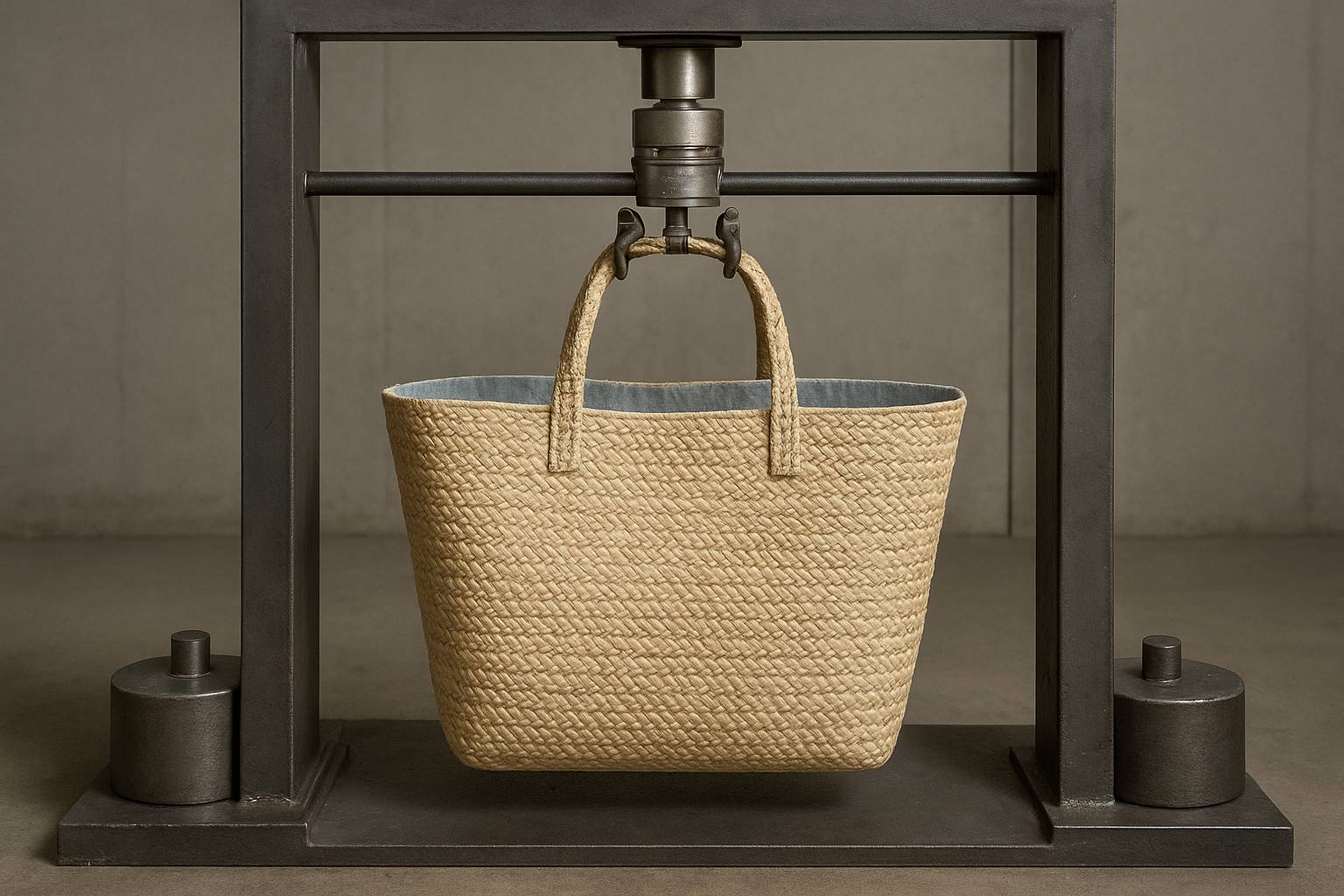
Setup: Clamp the tote body in a sturdy frame. Attach calibrated weights or a load cell to the handles so the pull is axial and reflects real use.
Procedure: Hold 12 kg for 60 seconds. If it passes, increase load in 2–5 kg steps to determine failure load (target ≥ 25 kgf). Photograph pre/post; record elongation at the attachment and where the failure initiates (stitch popping, raffia tear, rivet pull‑through).
Acceptance: No seam opening or stitch pop at 12 kg for 60 seconds; failure mode and load documented.
Why it matters: SATRA’s luggage programs include static and “snatch” style loads; while not handbag‑specific, the principles translate to tote handles and give buyers confidence when you show structured results. See the public overviews of these luggage tests in SATRA’s luggage testing spotlight (publisher: SATRA) and the SATRA test method catalogue.
2) Handle fatigue (cyclic lift)
Apparatus: A simple reciprocating rig that lifts a payload between 0 and 12 kg with a 150–250 mm stroke at 30–60 cycles/min. Add a cycle counter and guards.
Procedure: Run 5,000 cycles. Pause at 500–1,000‑cycle intervals for inspection.
Acceptance: No visible pull‑out, reinforcement failure, or stitch breakage; elongation ≤ 10%.
According to SATRA’s public descriptions of luggage fatigue, repetitive lifting to thousands of cycles is a recognized approach; calibrate the duty cycle to keep motor heat and fixture wear under control.
3) Abrasion (Martindale concept)
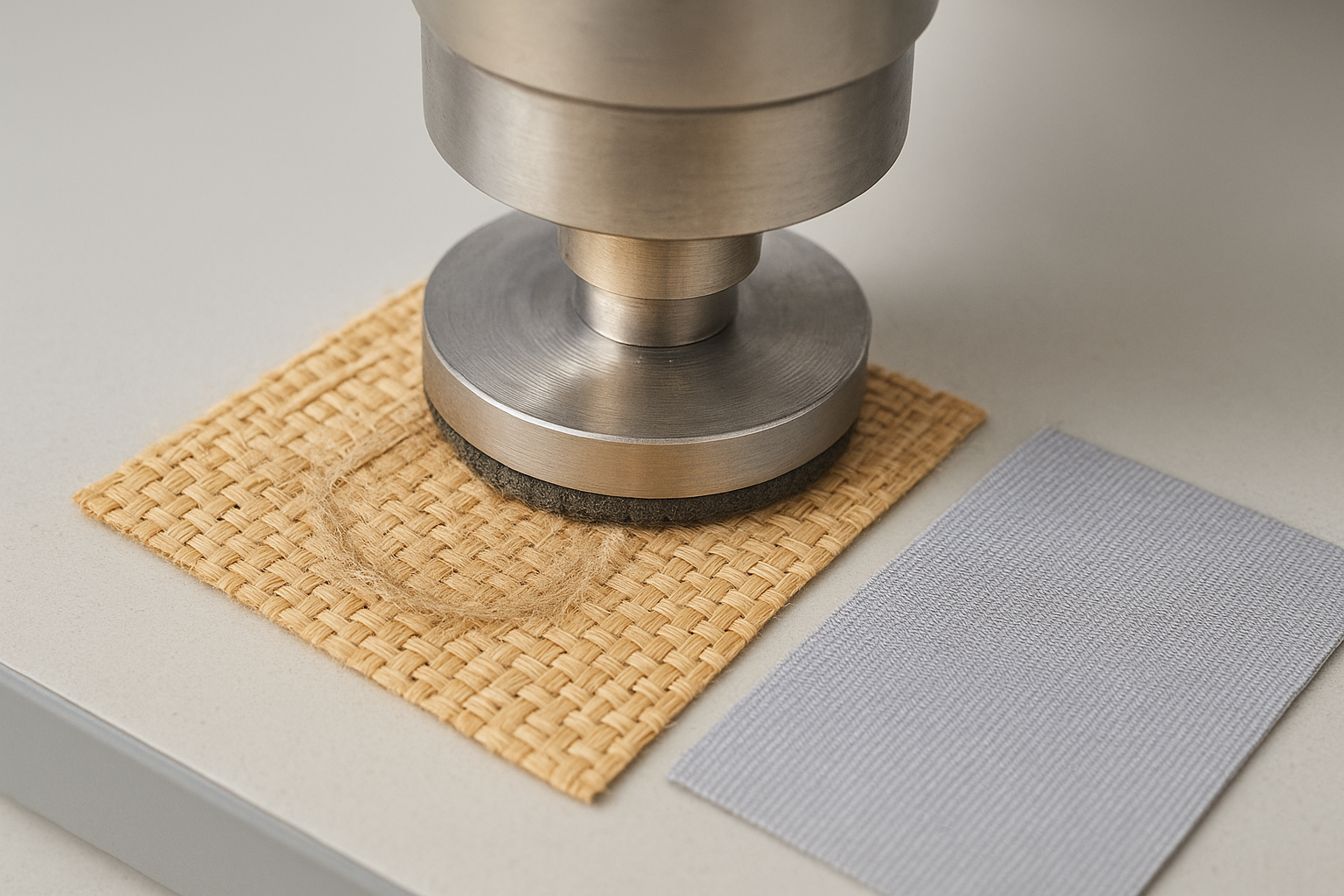
Scope: Test raffia body panels, handle wraps, and lining facings.
Procedure: Use a Martindale or equivalent reciprocating abraser with a standard abradant (e.g., wool or cotton). Run 5,000 rubs. Inspect at intervals for fuzzing, yarn breaks, or holes.
Acceptance: No hole or structural failure at 5,000 rubs; only slight, uniform fuzzing acceptable. For background on the method and common application ranges, see an industry explainer on the Martindale abrasion test (ISO 12947) (publisher: Xometry Resources).
4) UV/lightfastness and rPP weathering
Fabrics/raffia color: Expose swatches to a xenon program and grade against a Gray Scale, targeting Grade ≥ 3 after the agreed exposure. Report the total hours and program option. For a primer on xenon lightfastness options and Gray Scale grading, review AATCC’s colorfastness to light overview (publisher: QIMA, 2024 guide).
rPP components/linings: Use a fluorescent UV chamber (UVA‑340) for 300–500 hours with condensation cycles. Report both hours and radiant exposure (kJ/m² at 340 nm). Public lab pages outline ISO 4892‑3 practices; see Micom’s ISO 4892‑3 overview (publisher: Micom Laboratories) for parameters and reporting conventions.
5) Salt, sweat, and sunscreen/oil interaction
Sea water and perspiration: Follow public summaries of ISO sea water and perspiration methods. Evaluate color change and staining on the Gray Scale, targeting ≥ Grade 3–4. A practical primer is Testex’s color fastness to perspiration guide (ISO 105‑E04/AATCC 15).
Sunscreen/oil + abrasion (custom): Prepare a representative oil/sunscreen blend. Apply 0.5–1.0 mg/cm² to handle edges and high‑touch zones. Dwell 24 hours at ambient or 40 °C. Then abrade (e.g., 2,000 Martindale rubs) and re‑test peel adhesion. Acceptance: No tacky exudate, no delamination, color change within Grade 3–4, peel strength retention ≥ 80% vs baseline.
6) Sand ingress and functional checks
Procedure: Place the bag in a sealed shaker with 500 g of standardized dry sand for 1,000 reciprocations. Afterward, check lining abrasion, closure action, and ease of cleaning with a standard vacuum.
Acceptance: No seam opening; closure operates normally; only minor cosmetic dusting allowed.
7) Lining puncture and peel adhesion (rPP)
Puncture: On a universal testing machine with an annular clamp, drive an 8 mm probe at ~300 mm/min through a 100 mm specimen (D4833‑style). Record maximum force (N). Targets: ≥ 50–100 N for thin films; set higher for reinforced liners.
Peel (adhesion): Prepare 25 mm‑wide strips of lining bonded to the raffia interface or tape. Test 180° peel at ~152 mm/min (D903 concept). Report average force per 25 mm and failure mode. Repeat after UV, heat/humidity aging, and oil exposure; target ≥ 80% retention.
8) Accelerated aging (heat/humidity)
Procedure: Expose full bags or bonded coupons to 60 °C / 70% RH for 72 hours. Cool 24 hours, inspect for odor, wrinkling, or adhesive creep. Re‑test adhesion and key seams.
Acceptance: No delamination; adhesion retention ≥ 80%; no objectionable odor.
Sampling, AQL, and record‑keeping
Sampling for destructive tests: For each lot, allocate 3–5 units per destructive test type (handle static/fatigue, puncture/peel), depending on lot size and buyer agreement.
AQL for inspections: Use common softlines plans (Critical 0.0%; Major 1.5–2.5%; Minor 4.0%) with General Inspection Level II. For a clear explainer and calculator used by buyers and factories, see QIMA’s AQL guide (publisher: QIMA).
Why be this specific? Because clean records turn a “we tested it” claim into something buyers can audit and accept.
HANDBRAID micro‑example: a practical handle‑fatigue setup
At HANDBRAID’s test bench, the QA team outfits a simple reciprocating rig with an adjustable payload and a digital counter. A beach‑size raffia tote is mounted by its real handles. The stroke is set to 200 mm at 30 cycles per minute; the payload cycles from 0 to 12 kg. Every 1,000 cycles, the operator pauses, measures handle‑attachment elongation at the stitch bar, and photographs the area under the same lighting.
A recent illustrative run (for training purposes) reached 5,000 cycles with elongation holding at 6–8% and no stitch breakage or reinforcement loosening. The static hold test on a sister sample recorded no opening at 12 kg for 60 seconds and a failure load of 28 kgf, with first stitch pop observed at 27 kgf. Post‑fatigue, the bag passed 2,000 Martindale rubs on the handle wrap with only slight fuzzing and no yarn breaks. The team logged all parameters and results using the CSV header shown above and archived images in a shared drive. While these numbers are illustrative rather than third‑party‑certified, this workflow demonstrates how a factory can generate credible, repeatable evidence a buyer can sign off on.
Sourcing, references, and next steps
Luggage handle test principles: Public overviews from SATRA describe static, snatch, and fatigue concepts that translate well to handbags; see the SATRA luggage testing spotlight.
Abrasion and colorfastness: A practical explainer of the Martindale abrasion test (ISO 12947) covers end points and common ranges; for rubbing colorfastness, consult AATCC primers (e.g., Testex’s perspiration guide linked above) and your lab’s crocking SOPs.
UV weathering: For plastics and rPP, public lab pages outline ISO 4892‑3 UVA‑340 programs; see Micom’s ISO 4892‑3 overview and your chamber vendor’s guide.
AQL plans: Buyers frequently use the QIMA AQL guide to align plan selection and acceptance levels.
When you formalize this matrix in your SOP, consider adding internal photos of fixtures and failure modes. If you need third‑party validation or chamber time, contact SGS, Intertek, or Bureau Veritas.
Internal resources:
Explore the craftsmanship behind our weaving and finishing approaches on the HANDBRAID site: craftsmanship in production.
For OEM/ODM requests and integrating these tests into your tech packs, see: custom service and development.
Final notes
Here’s the deal: a clear, custom in‑house matrix—anchored by handle pull‑out prevention—beats vague promises every time. Start with the thresholds above, tune with pilot data, and publish the SOP so buyers can audit and trust it. If you also need a printable one‑page record sheet or a rig bill of materials for durability testing raffia tote recycled PP lining, reach out and we’ll share a template.