Types of Raffia Bags: A B2B Sourcing and Range-Planning Guide
For brand managers, retail buyers, and private-label entrepreneurs, "types of raffia bags" is not a styling question — it's a sourcing and assortment-planning decision. Each silhouette carries a different production complexity, minimum order quantity, price ceiling, customization scope, and role within a balanced range. Choosing the right mix is what separates a raffia collection that sells through cleanly from one that ties up capital in slow-moving SKUs.
This guide classifies raffia bags the way a buyer should think about them: by silhouette, by construction technique, and by material — with the commercial implications of each spelled out. If you need the foundational background on the material itself, our pillar guide on what a raffia bag is covers fiber, sustainability, and supplier selection in full. Here, the focus is on which types to build a profitable range around.
How to Classify Raffia Bags for Sourcing
Most consumer-facing content sorts raffia bags by occasion. For B2B decision-making, three classification axes matter far more:
By silhouette — determines retail positioning, price ceiling, and shelf appeal.
By construction technique — crochet, woven, or braided — determines labor hours and therefore cost.
By material — natural raffia, paper, seagrass, cotton, or recycled PP — determines price point, certification fit, and which market segment a SKU can serve.
A buyer who understands all three axes can specify a bag precisely, predict its cost, and place it correctly in an assortment. We'll work through each.
Raffia Bag Types by Silhouette
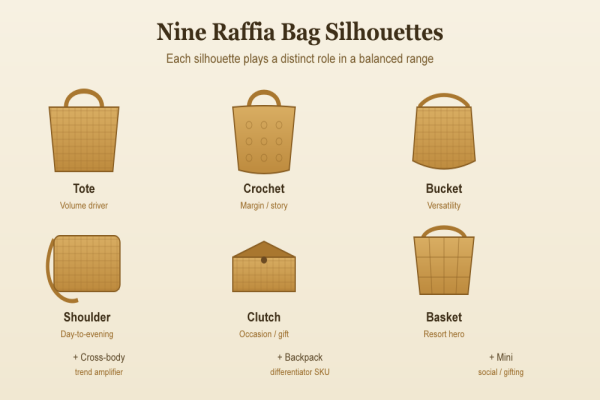
The table below summarizes the major silhouettes through a commercial lens — the practical view a buyer needs when planning an order.
| Silhouette | Production Complexity | MOQ Suitability | Indicative Retail | Role in Range |
|---|---|---|---|---|
| Tote | Low–Medium | Excellent for pilots | $40–$300 | Volume driver |
| Crochet Bag | High | Best at scale | $60–$500+ | Margin / story piece |
| Bucket Bag | Medium | Good | $80–$400 | Versatility, repeat purchase |
| Shoulder Bag | Medium–High | Good | $90–$600+ | Day-to-evening anchor |
| Clutch | Medium | Flexible | $50–$350 | Occasion / gifting |
| Basket Bag | Medium | Good | $70–$280 | Resort hero piece |
| Cross-body | Medium | Good | $80–$400 | Trend amplifier |
| Backpack | High | Best at scale | $120–$500 | Differentiator SKU |
| Mini Bag | Medium | Flexible | $40–$250 | Social / gifting driver |
Tote Bag — The Volume Anchor
The raffia tote is the highest-volume seller in the category and the safest first SKU for any buyer entering raffia. Its open-top, two-handle construction is relatively low in production complexity, which keeps unit cost manageable and makes it well suited to smaller pilot runs. For wholesale buyers, the tote is the dependable base of the range — strong sell-through, broad appeal, and an easy entry price. Sub-variants (unstructured market tote, lined beach tote, leather-trimmed day tote) let you ladder price points within a single silhouette.
Crochet Bag — The Margin and Story Piece
A raffia crochet bag is built strand-by-strand rather than from woven panels, producing the soft, intricate, texture-rich pieces that have dominated luxury runways. Production complexity is high — a detailed pattern can require 12–20 hours of artisan work — which is exactly why it commands the highest retail price ceiling in the category. For buyers, the crochet bag is the margin driver and the "story piece" that justifies a brand's craftsmanship positioning. Because it is labor-intensive, it performs best with a supplier that has deep, trained artisan capacity rather than a small workshop.
Bucket Bag — The Versatility Play
The bucket silhouette bridges casual and refined, giving it broader wardrobe versatility than a basic tote and driving repeat purchase. Medium production complexity and a $80–$400 retail band make it a reliable mid-range performer that sits comfortably in the contemporary lifestyle segment.
Shoulder Bag — The Day-to-Evening Anchor
Often the single piece a consumer buys to work across occasions, the shoulder bag — typically finished with a leather or chain strap — has been heavily adopted by luxury houses, which elevates its perceived value across the market. Medium-to-high complexity and a high price ceiling make it a strong anchor SKU for brands positioning above entry level.
Clutch — The Occasion and Gifting SKU
The clutch is where raffia meets formalwear. Its small surface area makes it the natural canvas for a factory's most elaborate craftsmanship — embroidery, beadwork, contrast trims — which makes it a profitable category for brands willing to invest in detail. Flexible on MOQ and strong as a gifting item.
Basket Bag — The Resort Hero
Structured and rigid, the basket bag is unapologetically vacation-coded and performs especially well in resort retail, hotel boutiques, and as a lifestyle brand's summer hero piece. Its stiffer weave holds shape under load.
Cross-body Bag — The Trend Amplifier
Compact and hands-free, the cross-body skews younger and reflects broader demand for utility-driven design. Often combined with leather straps and metal hardware, it works well as a trend amplifier and social-media-friendly SKU.
Backpack — The Capability Differentiator
The raffia backpack is niche but fast-growing, and it separates capable manufacturers from under-equipped ones: the form requires rigid structure, multiple straps, internal compartments, and reinforced stress points. For buyers, it's a differentiator SKU best ordered from a factory with proven structural-construction experience.
Mini Bag — The Social and Gifting Driver
Trend-driven and statement-led, the mini bag delivers strong margin and gifting appeal despite limited capacity. Lower material cost per unit, but design execution must be flawless because the small canvas leaves no room for error.
For the consumer-facing styling perspective on these silhouettes, the pillar guide includes a full style-by-style breakdown.
Raffia Bag Types by Construction Technique
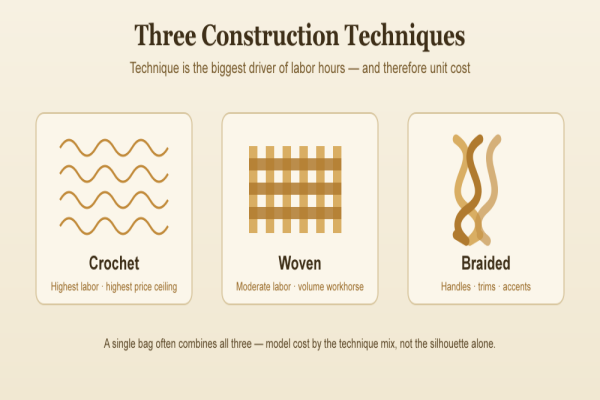
Construction technique is the single biggest driver of unit cost, so buyers should specify it deliberately rather than leaving it to the supplier.
Crochet — single-strand interlocking loops formed with a hook. Highest labor, highest price ceiling, most intricate patterns. Choose it for premium and story pieces.
Woven — strands interlaced in warp-and-weft panels. Moderate labor, structured shapes, efficient for totes and baskets. The workhorse technique for volume SKUs.
Braided — strands plaited into cords, used for handles, trims, and accents, often combined with the above.
A single bag frequently mixes techniques — a woven body with a crocheted panel and braided handles, for example. Understanding the labor profile of each lets a buyer model cost realistically and avoid the false economy of expecting crochet-level detail at woven-panel prices. For a full breakdown of how these techniques are executed on the floor, see our companion guide on how a raffia bag is made, and our craftsmanship page.
Raffia Bag Types by Material
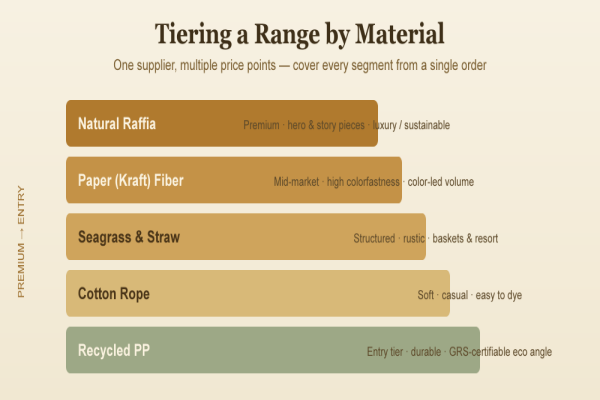
One of the most important — and most overlooked — ways to classify the category is by material, because it determines price point, certification fit, and which retail segment a SKU can serve. HandBraid produces across the full natural- and recycled-fiber spectrum, which lets buyers build a tiered range from a single supplier.
Natural raffia — the premium tier. Soft, biodegradable, the gold standard for luxury and sustainable positioning. Highest perceived value; pairs naturally with crochet construction.
Paper (kraft) fiber — high colorfastness and excellent for vibrant, consistent color customization. A strong, cost-effective mid-market option when bold color matters more than fiber prestige.
Seagrass and straw — structured, rustic, ideal for baskets and resort silhouettes that need to hold shape.
Cotton rope — soft, casual, and easy to dye, suited to relaxed everyday styles.
Recycled PP — the entry tier with a sustainability angle (GRS-certifiable), giving buyers a durable, lower-cost SKU that still supports an eco narrative.
This material range matters commercially because it lets a brand cover multiple price points and compliance needs — premium natural-raffia hero pieces, color-driven paper-fiber volume sellers, and recycled-PP entry items — without splitting the order across several suppliers. HandBraid also extends the same materials into woven storage baskets and crochet hats, useful for buyers building a broader accessories or home assortment.
Building a Balanced Range: A Buyer's Framework
The most common mistake brands make entering the category is launching too many silhouettes at once. A more disciplined approach anchors the line around 2–3 core styles and expands based on early sell-through. The structure below has worked across HandBraid client launches:
| Silhouette | Share of Range | Commercial Role |
|---|---|---|
| Tote | 30–40% | Volume driver, entry price |
| Crochet Bag | 20–25% | Margin driver, story piece |
| Shoulder or Bucket | 15–20% | Versatility, repeat purchase |
| Clutch | 10–15% | Occasion piece, gifting |
| Mini / Cross-body | 5–10% | Trend amplifier, social driver |
Layered over the silhouette mix, a smart buyer also tiers by material — using natural raffia for the hero and story pieces, paper or seagrass for color-led volume, and recycled PP for the accessible entry SKU. This two-dimensional planning (silhouette × material) is what turns a list of products into a coherent, margin-balanced collection.
Why Type Selection Is a Commercial Decision
Each type carries a different risk-and-return profile. Totes minimize launch risk but compress margin; crochet pieces build brand equity and margin but demand artisan-rich production; backpacks and structured baskets differentiate but require a capable factory. Getting the mix right is the difference between a collection that funds its own expansion and one that strands inventory.
This is also where supplier capability becomes decisive. A small workshop can make a beautiful one-off but cannot run nine silhouettes across three materials at consistent quality and scale. A production-grade factory can — which is why type planning and supplier selection are really the same decision.
HandBraid is built for exactly this kind of range: 30+ years of handcraft experience, 1,000+ in-house-trained artisans spanning crochet, weaving, and braiding, an annual capacity of over 7 million bags and baskets, and the material breadth to produce every silhouette above in natural raffia, paper, seagrass, cotton, and recycled PP. With a full certification portfolio (BSCI, FSC, Sedex, ISO 9001, GRS, RoHS, CE, SGS), an MOQ from 300 pieces per style, samples in 3–7 days, and bulk production in 45–60 days, the factory supports both emerging-brand pilots and established seasonal rollouts. Both OEM and ODM services are available, with written brand-protection commitments on all designs.
To plan a range or develop specific types, request samples or a custom quote.
Frequently Asked Questions
Which type of raffia bag sells best for a new brand?
The tote is the safest and highest-volume entry SKU — low production complexity, broad appeal, and an accessible price point. Most brands anchor a first range with a tote, add a crochet shoulder bag or bucket for margin, and round it out with a clutch or mini for occasion and gifting.
Which raffia bag types have the highest profit margin?
Crochet bags and embellished clutches typically carry the highest retail price ceilings because of the artisan labor and detail involved. They serve as the margin and "story" pieces in a range, while totes drive volume at lower margin.
What's the minimum order quantity per raffia bag type?
It varies by supplier and complexity. HandBraid accepts custom orders from 300 pieces per style across silhouettes, making even labor-intensive types like crochet bags and backpacks accessible to emerging brands, though high-complexity styles are most cost-efficient at scale.
Can different raffia bag types be made from different materials?
Yes — and tiering by material is a core B2B strategy. The same silhouette can be produced in natural raffia (premium), paper fiber (color-led mid-market), or recycled PP (entry tier with a sustainability angle), letting a brand cover multiple price points from one supplier.
How many raffia bag types should a collection include?
For a first launch, 2–3 core silhouettes is the disciplined approach — typically a tote, a crochet or shoulder bag, and a clutch — expanding into bucket, cross-body, basket, backpack, and mini styles based on sell-through data rather than launching everything at once.
Which raffia bag types require the most capable manufacturer?
Backpacks and structured basket bags demand the most from a factory, because they require rigid structure, multiple straps, internal compartments, and reinforced stress points. Intricate crochet bags also require deep, trained artisan capacity. These types reliably separate production-grade factories from small workshops.
Explore HandBraid's full range — crochet bags, straw bags, paper bags, cotton bags, recycled PP bags, and woven storage baskets — or learn about our custom OEM/ODM services and contact our team to plan your collection.