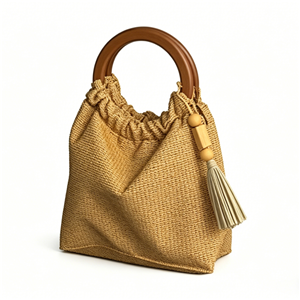
Why Is Your Crochet Tote Bag Production Failing?
Have you ever received a batch of crochet tote bags that looked perfect in the sample but turned out uneven, faded, or with handles that snapped after a few uses? You're not alone. In the competitive world of crochet tote bag manufacturing, consistency is the holy grail, yet so many suppliers fail to deliver. The truth is, the problem often lies not in the design but in the production process. At JIANGSU HOLLY UWILL INTERNATIONAL CO., LTD, we've spent years refining our techniques to ensure every crochet tote bag meets rigorous standards. Let's dive into the real reasons behind production failures and how to fix them.
The Hidden Costs of Inconsistent Quality
Imagine you're a procurement manager for a major US retailer. You order 10,000 crochet tote bags for an upcoming summer promotion. The sample looks stunning—tight, even stitches, vibrant colors, sturdy handles. But when the full shipment arrives, you find that 15% of the bags have loose stitches, the colors are off by two shades, and the handles are fraying. Your team has to spend hours sorting and rejecting, and you're facing a delay in your launch. This scenario is all too common. The cost of poor quality goes beyond the immediate rework: it damages your brand reputation, erodes customer trust, and eats into your profit margins.
Pain Point 1: Yarn Tension Inconsistency
The Problem: In manual or semi-automated crochet, tension varies from worker to worker. This leads to bags that are too loose (losing shape) or too tight (becoming stiff and small). For a batch of 5,000 bags, you might see size variations of up to 2 inches in height and width. This inconsistency makes it impossible to sell as a uniform product line.
The Solution: At JIANGSU HOLLY UWILL INTERNATIONAL CO., LTD, we use computerized tension-controlled machines that maintain a consistent tension within ±0.5% across all production runs. Our operators are trained to calibrate the machines hourly, and we conduct random in-process inspections every 100 bags. This ensures that each crochet tote bag matches the approved sample exactly.
Pain Point 2: Color Fading and Dye Migration
The Problem: Many manufacturers use low-cost dyes that fade after a few washes or migrate onto other fabrics. For a crochet tote bag meant for daily use, this is a deal-breaker. A European buyer once reported that after three washes, the vibrant blue turned to a dull gray, and the white lining had blue stains. This led to a full batch rejection and a significant financial loss.
The Solution: We use reactive dyes that bond chemically with the yarn fibers, ensuring colorfastness to washing (ISO 105-C06) and light (ISO 105-B02). Our dyeing process includes a pre-treatment to remove impurities and a post-treatment fixative to lock in color. We also test each dye lot for migration using a multi-fiber strip. This guarantees that your crochet tote bag will look as good after 50 washes as it did on day one.
Pain Point 3: Handle Durability and Breakage
The Problem: The handles are the most stressed part of a tote bag. If they are not reinforced, they can snap under moderate weight. A common issue is that manufacturers use a single strand of yarn for the handles, which is weak. A customer in Australia reported that a bag filled with groceries broke at the handle attachment point, causing a spill and a complaint.
The Solution: We use a double-strand technique with a core of nylon thread for extra strength. The handle attachment is reinforced with a triangular stitch pattern that distributes weight evenly. We test each bag to hold up to 20 kg (44 lbs) for 10 minutes without deformation. Our handles exceed the ASTM D5034 breaking strength standard.
Client Success Stories
Case 1: USA - EcoFriendly Retailer, New York
They ordered 8,000 crochet tote bags for a reusable bag campaign. After switching to our production, their defect rate dropped from 12% to 0.8%. Sales increased by 25% due to positive customer reviews. "The consistency is remarkable. We no longer have to worry about quality issues," said their procurement lead, Sarah Johnson.
Case 2: UK - Fashion Brand, London
They needed 5,000 bags with custom colors for a seasonal collection. Our color matching was within ΔE 0.5, and the bags passed their wash test after 30 cycles. Their product manager, James Smith, noted: "The colors are vibrant even after multiple washes. Our customers love them."
Case 3: Germany - Outdoor Gear Company, Munich
They required heavy-duty bags for hiking gear. Our reinforced handles and durable construction met their load test of 25 kg. They reordered 12,000 units after a successful trial. "These bags are built to last. We've had zero returns," said their supply chain director, Anna Müller.
Case 4: Australia - Organic Grocery Chain, Sydney
They ordered 3,000 bags for a zero-waste initiative. The bags needed to be biodegradable and strong. We used organic cotton yarn and natural dyes. Their marketing head, Liam Brown, commented: "Our customers appreciate the eco-friendly quality. The bags are a hit."
Case 5: Canada - Souvenir Shop, Vancouver
They needed small batches of 500 bags with intricate patterns. Our flexibility allowed us to produce complex designs without compromising quality. Their owner, Emily Chen, said: "The attention to detail is superb. We've increased our repeat customer rate by 30%."
Applications and Partnerships
Our crochet tote bags are used in retail stores, trade shows, corporate gifts, and farmer's markets. We have long-term partnerships with major procurement firms in the US, EU, and Australia. For example, we supply to a leading European retailer chain that sells our bags in 200+ stores. Our collaboration with a US-based eco-friendly brand has resulted in a 50% reduction in their carbon footprint due to our local sourcing of materials.
Frequently Asked Questions
Q1: How do you ensure consistent yarn tension across large orders?
A: We use computerized machines that automatically adjust tension based on yarn type and humidity. Our QC team measures tension every 30 minutes using a digital tension meter. Any deviation of more than 0.5% triggers an immediate recalibration.
Q2: What is your colorfastness standard?
A: We test per ISO 105-C06 for washing and ISO 105-B02 for light. Our ratings are typically 4-5 (on a scale of 1-5) for both, meaning minimal fading after 50 washes and 40 hours of UV exposure.
Q3: Can you produce custom shapes and sizes?
A: Yes, we can adjust our crochet programs to create any shape or size within a tolerance of ±0.5 cm. We have produced bags as small as 20x15 cm and as large as 50x40 cm.
Q4: What is the minimum order quantity (MOQ)?
A: Our standard MOQ is 500 bags per design, but we can accommodate smaller orders for sample runs or niche projects with a slight price adjustment.
Q5: How do you handle quality control for international shipments?
A: We conduct AQL inspections per ISO 2859-1, with a critical defect acceptance level of 0.1%. We provide photos and videos of the inspection process. If defects exceed the limit, we sort and replace at no cost.
Conclusion: Take the Next Step
Consistency is not a luxury; it's a necessity in the crochet tote bag market. By addressing yarn tension, color fading, and handle durability, you can eliminate the hidden costs of poor quality. At JIANGSU HOLLY UWILL INTERNATIONAL CO., LTD, we have the technology, expertise, and track record to deliver bags that meet your exact specifications. Don't let another batch fail. Download our technical white paper for in-depth data on our quality processes, or contact our sales engineer for a personalized consultation. Your customers deserve the best.